

By Rebecca Shoesmith
It’s true what they say about travelling, whereby you “find yourself”. However, instead of returning knowing how to say the country’s name in its native language, you realise your own potential and uncover what the world has to offer.
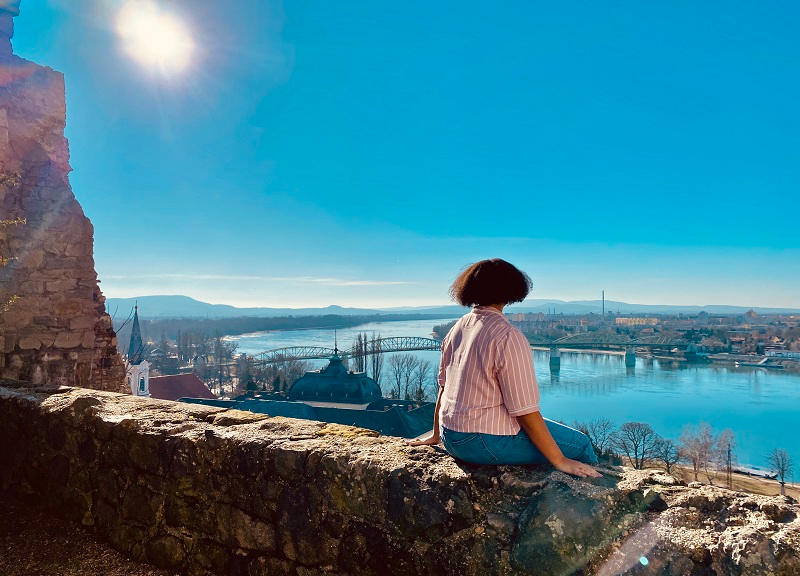
When I was 17 years old, I went abroad for the first time without my parents. My sister took me to Budapest and I instantly fell in love with the city. I knew that there was more to explore beyond four days of sightseeing. Flash forward three years, I had the opportunity to study Psychology in Budapest for a year with Erasmus+. I couldn’t say no, and I didn’t say no…
I put Eötvös Loránd University (ELTE) in Budapest as my top option out of three universities in Europe and fortunately I obtained a place. I soon found out that another person on my course at NTU, Lauren, was going to attend ELTE at the same time. After going for a coffee, Lauren and I decided that it would be best if we lived with each other because of how significant a move to another country would be, and also so we bring the Nottingham nightlife to Budapest. After filling out paperwork, choosing modules, completing a risk assessment, and booking our accommodation, we arrived in the picturesque city in September 2019.

Most people are apprehensive about moving to another country but honestly, I was thrilled by the concept of pure independence. Despite studying at NTU providing me with the feeling of independence, I remained anchored to the roast dinner at home which was only a drive or train ride away. However, when being in a new country, I realised that I either must learn how to make Yorkshire puddings or try my hardest to find a shop that sells British food. One thing I was worried about was whether I would make friends. I realised very early on that I wasn’t alone; Erasmus+ had a well-established network which connected students who were feeling the same way and allowed them to meet-up, interact and go on trips.
Academically, studying abroad helped me delve deeper into aspects of Psychology that I was always interested in but was not available at NTU. Modules I picked included Affective Psychology (the effects of motivation and emotion) and a Gender Perspective in Social Psychology. I also studied Clinical Psychology in Practice which allowed me to visit a psychiatric clinic and talk to an in-patient about their life and experiences. Furthermore, I was able to engage with modules beyond Psychology that provided me with transferable skills and a greater understanding of different cultures and societies. These included ‘Human and Minority Rights’, ‘Historical and Collective Trauma’ (namely the Holocaust) and ‘Beginners Yoga’.
Personally, I met a vast number of wonderful people whom I am grateful to know and be friends with. Lauren and I became a really good friends and roommates, and with her, we and others travelled to six countries including Serbia where we experienced a retro 1980s-inspired nightclub, and Romania where we tasted amazing food like Papanaşi (a cheese doughnut) and walked along a completely frozen lake.

There are many unexpected challenges you can face when living abroad but doing research prior to arriving is important at reducing the challenges and making you more aware. For instance, with booking accommodation and conversing with landlords, try avoid paying rent in cash as it doesn’t leave you with any record of payments. Also, if you have to pay bills, photograph each bill statement and keep the receipts. In terms of taxi drivers, familiarise yourself with the currency exchange as some taxi drivers may try and overcharge you because they think you are a tourist. Importantly, make sure your taxi drivers are legitimate. This can be a little difficult but pay attention to company logos. I would suggest ordering taxis on Bolt, the Uber of Budapest. Finally, in Hungary I would highly suggest only taking money out from a Bank. Non-Bank affiliated ATMs can charge cash withdrawal and have low exchange rates. Conversely, with Bank transactions you can specify keeping the exchange rate of your UK bank, which will be better than the exchange rate of a Hungarian Bank.
An unprecedented challenge Lauren and I faced, which could not have been avoided, was the COVID-19 pandemic. When the outbreak began, life in Hungary was more or less still proceeding as normal. University had stopped allowing students to attend in person, but like the rest of the world, online learning became the new norm. It was only when surrounding countries were shutting their borders did the climate become intense. In the news it was announced that Hungary was planning on stopping flights to the UK, so instantly I booked the earliest flight I could and it turned out I was on the last flight back to the UK. Many of my friends decided to stay in Budapest, however as Lauren had gone home prior to me, the fear of facing lockdown on my own loomed over me.
During the lockdown in the UK, with the support of my lecturers at my host University, I was able to complete my assessments despite being almost 1,500 miles away. In person exams either became essay submissions or took place online, but I still managed to obtain high grades. Throughout, Lauren and I were trying to figure out how to get back, as our luggage and belongings remained in our little flat in Budapest. One day there was a news release that in addition to Hungarian citizens, students in education in Hungary were able to return to Hungary if they filled out a form and showed it to the police. With the assistance of my Hungarian friend who helped me scribe an official letter in Hungarian, after 3 months Lauren and I managed to return to Budapest. We returned for over a month, and although we weren’t legally allowed to leave Hungary during our time, we were able to travel around Hungary and experience our last few days while wearing our face masks and regularly sanitising.
My experience of studying abroad has offered me with connections all around the world and I have expanded my knowledge of Psychology. I have understood the importance of experiencing different cultures and societies and it has provided me with a clearer picture of how I want my career to progress.
Some tips & recommendations:
- Make connections within the host university such as exchanging contact details with lecturers you had a rapport with – they will be beneficial in the long run
- If you plan on studying in Budapest, you must go to Lake Balaton, János-hegy, and Bite (a perfect café to study in and eat the best cinnamon rolls)
- Figure out how to manage your budget and do research before applying for a specific country, make sure you can afford it
- Get involved with new activities, as you will be offered opportunities you wouldn’t experience at home e.g. I tried sunrise Yoga on Margaret Island in Budapest and my friend fell in love with Bouldering
- Try to use the native language and make friends with the natives rather than just Erasmus+ students, you might just get invited to a wedding like I did!
- Engage in cultural exchanges – my friends and I put on cultural cooking nights where we learnt how to make each other’s home dishes (I now make amazing Polish Pierogi’s)
- Study and get good grades! But also travel, do everything you possibly can and take loads of pictures – you may come first place (or third, like me) in NTU’s Study Abroad / Exchange student photo competition.
- Acknowledge other cultures, ignore stereotypes and be active in understanding a culture’s history and people
- Keep in touch with the NTU Psychology’s Internationalisation Coordinator, Dr Glenn Williams. His role is to advise and support you while you are abroad.
- Keep in touch with NTU Global staff too and see if you can find out more about study abroad from those who have been there, seen it, and done it! NTU Global has students who have taken on the role of Student Exchange Buddies and they can be really useful for getting insider knowledge.
About the author
Rebecca Shoesmith is in her 4th Year of studies at NTU Psychology and is studying BSc (Hons.) Psychology (Mental Health).

 Psychology at Nottingham Trent University