

by Craig Harper
It’s a proud week for us here at NTU Psychology. Graduation is always a special time, where we get to enjoy and celebrate the success of our students. The end of one important part of their journey but the beginning of another exciting chapter. Our latest article, from NTU Psychology’s Craig Harper, reflects on another busy and successful year for us (including Craig being awarded the NTU Vice Chancellor’s Award for Excellence in Research!); Craig shares his insights into what goes on ‘behind the scenes’ of an academic’s working life to bring us to these special graduation moments.
So, whether you’re just curious, or perhaps you thinking about an academic career yourself, here’s Craig with some answers to the question “what do lecturers do when they aren’t lecturing?”
As I sit down to write this article it is the end of June 2022. Most core tasks for the year have come and gone without too many hiccups, and it is time to both take stock of the relative successes for this year, and to consider points for improvement as we look ahead to the next. However, while I sit making a list of the jobs done, things achieved, and things still left to complete on my (seemingly never-ending) to-do list, I realise that those we teach – our students – may only ever see the tip of this iceberg of work. In this article, as we look forward to graduations – one of the highpoints of our year – I hope to provide a bit of a glimpse ‘behind the curtain’ of an academic year.
As readers will no doubt be aware, the academic year runs from September to August, with teaching terms running from (approximately) October to December, January to March, and finally for a few weeks in April and May. In all, teaching takes up around 25 weeks of the academic schedule, or around half a calendar year.
This is where the first – and arguably most pervasive – social misconception of academia comes to the fore: that we “only work half of the year”. However, what many people do not see is the preparation that goes into preparing courses, modules, and individual sessions. So let’s explore a (roughly) month-by-month academic calendar…

September: This is a month characterised by planning. By this point, we know roughly how many students we’ll be expecting in a few weeks’ time, and we’re busy thinking through how to welcome everyone, and how best to teach them too. Within NTU Psychology this is a particularly busy time, with our first-year cohorts typically being as big as 650 students. Decisions are made about session types and who is teaching on which modules well ahead of this point, from the January or February before each academic year starts. However, this month is one where we prepare module ‘learning rooms’ (the online resources that accompany our teaching and host all the content students need), pull together timetables, write assessment plans, and get everything ready so that, hopefully, students can get straight into the business of learning content and thinking about psychology.
October-November: Our focus during this period is very much on teaching, and many academic staff will teach for several hours per week – my own timetable usually sits at around 14 hours. From a student’s eye view, this often looks like a member of staff coming into a session, speaking over some slides for an hour or two, and then retreating back to their office. This leads us to the second misconception – that teaching is often a relatively light-touch process.
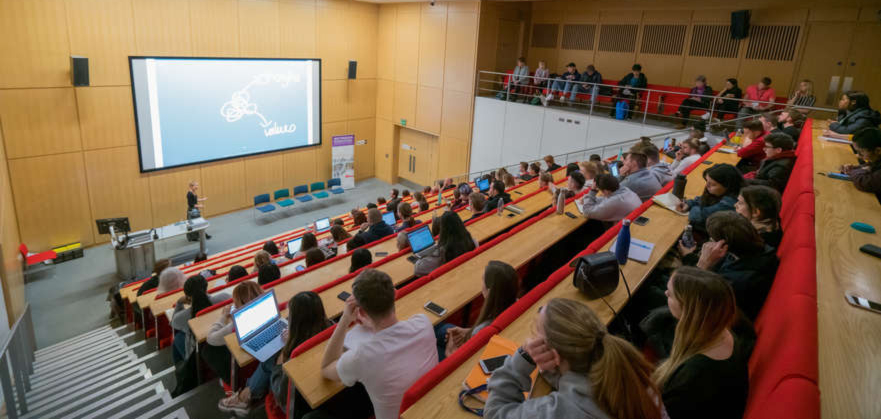
Teaching well at undergraduate level is challenging, particularly in a context that is marked by students understandably seeking value for money. Lecturers are naturally expected to be knowledgeable, entertaining, and passionate about their subject, and this is something we like to think that we do incredibly well here at NTU Psychology: in recent years the university has received several prestigious national awards, while NTU Psychology itself has consistently been recognised by our students in the National Student Survey (NSS), for student satisfaction. Doing this well takes a lot of thought and preparation. Lecturers often have previous years’ slides to work from, but even just re-learning the narrative of a session, making sure the technical aspects of topics are clear, and ensuring that materials are updated to reflect last-year’s feedback, or new research can mean that even a single one-hour lecture takes up to six or eight to hours prepare. However, not all of our teaching is formal lecturing; many of our sessions are more practical and student-led, where our role is more about facilitating discussion and group projects, rather than to stand and present for the full session.
On top of this, many academics are also thinking about the future in these early parts of the teaching year. For example, those who wish to apply for promotion (to Associate Professor, or Professor) need to submit applications soon after Christmas, and will be starting to pull together the evidence for their application forms in November or December. Meanwhile, those who wish to launch a new module in the following academic year will also need to write new module specifications now, as these need to be reviewed and approved by a committee in January.

December: The light at the end of the Term 1 tunnel starts to emerge as we enter December. Most modules wind up in the first or second weeks of December, which means that lecturers begin to find more flexibility over their day-to-day activities and other tasks begin to take over. Many will turn to their research, trying to write papers that have been neglected since the summer in an attempt to submit them for peer-review before the festive break. The academic publishing process can be a long one, and papers submitted to journals in December may not be fully complete until the following summer or autumn – so there’s no wonder some academics see their papers as their babies!
Others will be preparing module teams to mark student assessments submitted early in January. This usually means finding assessment examples from the previous year, sending these to all markers, and asking people to assign a grade to this work. There is then a meeting that happens where marker views are ‘calibrated’ to ensure that all markers on a module are singing from the same hymn sheet, as it were. This is a really time-consuming process, and is important to ensure that marking across modules is consistent and fair.
Once the third week of December comes by, most of us are finishing our work and making plans for the holidays, and return in the first or second week of January.
January-March: The early months of the new calendar year work in pretty much the same way of October-November, with an increasing emphasis on project supervision. Final-year students, and those on Master’s level courses, all complete research projects as a part of their degree, and they are each supervised by a specific member of staff. Although supervision usually begins in the first term, it steps up a gear after Christmas, with data collection (for primary research) and data analysis becoming the jobs that need completing.
As we head towards the end of term, many staff (myself included) usually run additional assessment support sessions to help students on all modules achieve their potential. The same marking arrangements as term one are also repeated here, to make sure that all markers know what to expect, when to expect it, and that grading is consistent.

April-June: This period is characterised by admin. At the end of the second term, all staff are in a race against time to ensure that students know when to submit work, to get assessments marked, and to submit those grades to the university. The reason for this rush is that the university has a central deadline so that ‘exam boards’ can happen, to ensure students can progress to the next year of study or graduate. Exam boards are big meetings that can last anywhere from two to six hours and they involve all course leaders, module leaders, external examiners, and university administrators; the aim being to confirm student grades and, hopefully, to award good degree classifications. In these meetings, every student is considered individually, meaning that grading needs to be accurate and complete so that we can make decisions about whether they have passed, and at what level.
This is arguably the most pressing and time-pressured part of the academic year, and it is not uncommon for staff who lead courses to spend entire days looking at spreadsheets, analysing grade trends, and writing recommendations for student awards.
July-August: In comparison, these months are relatively calm. Most staff will not be able to take any annual leave during teaching time for obvious reasons, meaning that holiday time will have accrued to be taken here. This means that July is comparatively quiet around the university, apart from graduation time when excitement and celebration return to campus . Those who aren’t taking leave (and, in many cases, those who are) will usually work on personal projects, such as books they are writing, or research papers they’re trying to publish.

August picks up speed again, as students who were unable to submit assessments during term or that were not passed in the first instances submit their assessments for marking. The same marking arrangements, chasing grades, and preparation for exam boards happen again here, albeit with lower numbers of students to consider. Then, in the third week of August, is A-Level results day, and Clearing. At this point, the university will have a reasonable idea of the number of students to expect the following year, but we often see a rush of applications through Clearing for any remaining spaces on courses. It’s only at this point that we will know for sure.
The Unseen Jobs: And there are tasks I have not discussed. For example, I am an external examiner for courses at another university, and this takes up time; external examiners moderate and check that university courses, assessments, and grading are appropriate and fair. We have external examiners from other universities supporting us here at NTU too, giving us feedback to help ensure we are the best we can be. Academics also publish research, supervise doctoral-level students, offer personal tutoring and support to students, and complete administrative tasks such as attending open days to inspire future students about studying with us. These are ongoing tasks that we fit around our teaching, marking, and student supervision tasks.

In Conclusion…Hopefully this peek behind the curtain has identified how busy and varied an academic life can be. None of this is to complain about the job at all. Is it often tough? Sure. Are the hours long? Absolutely – more than a third of UK academics work more than 50 hours per week to fit everything in. But is there anything else I’d rather be doing? Definitely not! However, this article was designed to give an insight about what your lecturers are doing throughout the year – in the background – to make our students time with us at NTU Psychology as smooth, intellectually stimulating, and enjoyable as we can.
So, having just finished exam boards, attention turns to planning for the referral period and making arrangements for August’s work. As we look forward to July’s celebration of our students’ success at graduation, you’ll recall that we’re about to enter the season of rest. So, for those who are graduating, we hope you have a special day, and for the rest of you, enjoy your summer and we’ll see you back refreshed for the next academic year!
- Image credit: Post-It planning: Photo by Hugo Rocha on Unsplash
- Image credit: Passion led us here: Ian Schneider on Unsplash
- All other photos from Nottingham Trent University
 Psychology at Nottingham Trent University
Comments are closed.