
Decades of literacy research have shown us the core skills required to become a good reader: children firstly need to be able to decode the print on the page, but then also move on to a more fluent stage including reading with proper expression, and of course they need to understand the meaning of what they are reading. Research has revealed effective strategies for developing these core skills. For example, understanding that words are composed of different speech sounds that can be recombined and blended to make different words, and learning the systematic relationship between letters and sounds will set most children on a successful path to decoding. Having an adult model reading with expression and the opportunity to practice themselves will help children become fluent. Improvements in vocabulary and understanding that stories are structured with beginnings and endings, and characters and settings will all help children to make sense of what they read.
Mostly, children acquire these skills in the normal course of their primary education, and if they don’t there are interventions available to target specific needs. Typically, children learn reading skills first (using phonics) before they move on to comprehension instruction, and these skills are also often evaluated separately by researchers. But meaningful school measures (KS1 SAT’s) assess both reading ability and comprehension ability in one measure. What about a more balanced approach that integrates aspects of decoding, fluency and comprehension in a single programme that can be given to all children early on in their education to boost development? Would such a programme improve not only reading ability, but also educational outcomes that are meaningful to schools (like their KS1 SAT’s)?

We decided to test that idea with a project funded by the Education Endowment Foundation (EEF). We wanted to use a strong evidence base to develop a reading programme, and so we created a balanced reading programme aimed at all Yr 1 children, using a suite of online reading activities and stories (called ABRACADABRA, or ABRA for short) developed by Concordia University and a faculty member from McGill University. ABRA was developed based on decades of literacy research highlighting the types of knowledge and skills that promote the core reading processes evident in good readers. The activities are derived from research showing their effectiveness for developing phonics, reading fluency and reading comprehension.
The programme was delivered by trained school staff in 50 schools in the West Midlands who followed lesson plans that we provided. This delivery model mirrors more closely what happens in real life in schools – e.g. Teaching Assistants (TA’s) delivering interventions – and has the benefit of developing the skill set of the TA’s; a valuable knock on effect for the schools as the programme remained free to use after the study finished.
We made the intervention available in two forms: an ICT (Information & Communications Technology) version that was delivered through the ABRA website, and a paper version using the same activities and stories, but delivered using traditional resources such as paper, cards and magnetic letters. TAs delivered 15 minute sessions to groups of four pupils, four times a week for 20 weeks, either using the tech-based (ICT) or non tech-based (non-ICT) version. The sessions were supplementary to their normal literacy and any other literacy provision that schools were using.

What did we learn from this study?
In terms of hard facts, at the end of the intervention (1 academic year), the ICT (+2 additional months progress) and non-ICT (+3 additional months’ progress) programmes led to improved reading attainment measured by a standardised reading assessment. The improvements were larger (+5 additional months’ progress) for disadvantaged children (those on free school meals). There was no meaningful difference between the ICT and NON-ICT deliveries. More children who participated in the programme achieved or exceeded expectations in their KS1 SAT’s compared to children in the control condition – meaning on average the programme children had better SAT’s outcomes.
What was it about the programme that accounted for the rise in children who achieved or exceeded expectations in their KS1 SAT’s? We used something called a mediation model to test which aspects of the programme caused improvements in their KS1 SAT’s. This works by looking at which taught programme skills are improved by the programme (relative to the control condition), and then which – if any – of those skills improves the KS1 SAT’s, like this (below):
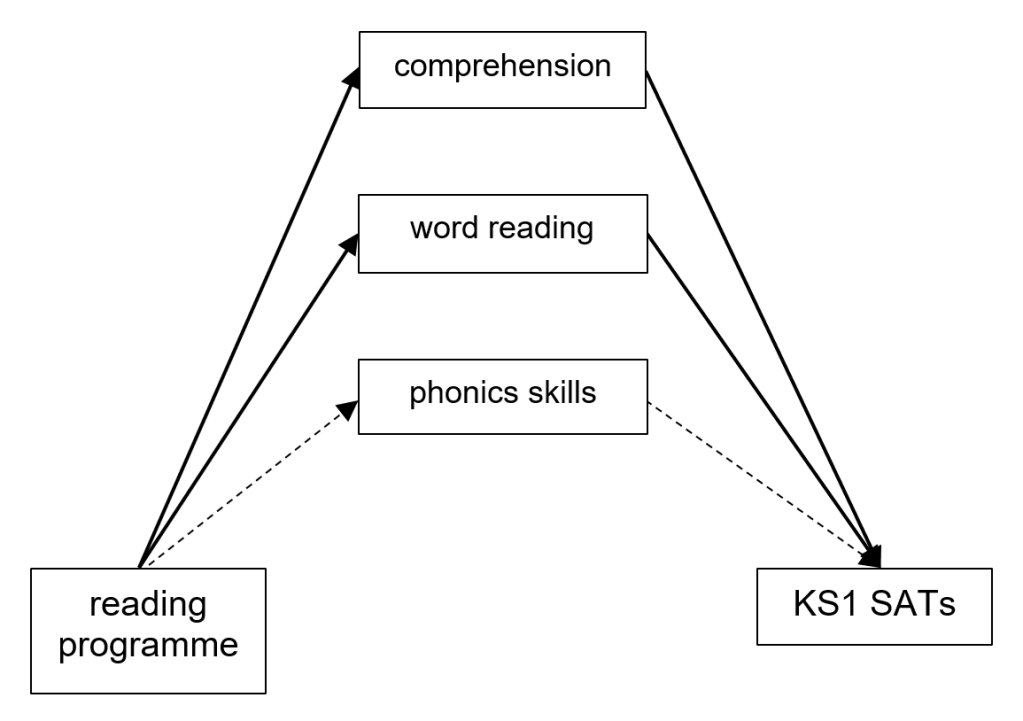
We found that the reading programme improved comprehension and word reading ability, which in turn accounted for the improvement in KS1 SAT’s (solid lines in above figure). Thus we can be confident that the reading programme improved the KS1 SAT’s scores by improving the comprehension and word reading skills taught to children in the programme. This is important because it shows which skills the programme teaches that are responsible for the improved outcomes, and that teaching comprehension skills alongside phonics skills can boost outcomes that are meaningful to schools, like the KS1 SAT’s scores. This is all the more important because we used a robust design with strict methodology allowing replication and generalisation. This contributes to a growing body of research aiming to identify ‘what works and why’ in educational settings, allowing schools to make evidence based decisions when choosing how to teach reading.
Find out more:
This research is published in the peer-reviewed articles below:
- Johnson, H., McNally, S., Rolfe H., Ruiz-Valenzuela J., Savage R., Vousden J. I., & Wood, C. (2019). Teaching Assistants, Computers and Classroom Management. Labour Economics, 58, 21-26. doi.org/10.1016/j.labeco.2019.02.006.
- Vousden, J. I., Cunningham , A. J., Johnson, H., Waldron, S., Ammi, S., Pillinger, C., Savage, R., & Wood, C. (2021). Decoding and comprehension skills mediate the link between a small-group reading programme and English national literacy assessments. British Journal of Educational Psychology. https://doi.org/10.1111/bjep.12441
- You can read more information about this project by following this link and the full Education Endowment Foundation report can be found here.
Image credits
- Header: Michał Parzuchowski on Unsplash
- Photo 1: Adam Winger via Unsplash
- Photo 2: Ryan Wallace on Unsplash
 Psychology at Nottingham Trent University