
A new wave of psychology at NTU
By Beth Jones
Have you ever thought about whether you are comfortable with your gender? Have you ever questioned your sexuality? For most of us, these won’t be questions we have encountered or, if they have crossed our minds, they are unlikely to have caused too much concern. However, for the LGBTQ+ community these are questions that have emerged and sometimes can cause significant psychological distress. LGBTQ+ stands for lesbian, gay, bi, trans, queer, questioning, ace (or asexual) and more. The ‘and more’ is included to capture the diversity of sexuality and gender identities. While this acronym captures umbrella terms relating to sexuality and gender, there are many, less common identities such as demiboy/demigirl (people who only partly identity as male or female) and polysexual (romantically and sexually attracted to partners of many but not all genders). It is also important to note that although both sexual and gender diversity are encompassed with in this acronym, these are different experiences that are not necessarily associated with one another. For example, someone might identify as gay and cisgender (the term used to describe people who identify as the same gender that they were assigned at birth) or someone might identify as bi and trans. There are no rules.
LGBTQ+ Health and Wellbeing Research Group at NTU
To support with this important yet understudied area of psychology, NTU recently launched a LGBTQ+ Health and Wellbeing Research Group. Dr. Beth Jones, senior lecturer at NTU Psychology, leads the group after realising the appetite for this exciting area of Psychology at NTU. Other core members of the group include Professor Daragh McDermott (Professor of LGBTQ+ and Social Psychology) as well as Dr Mohammad Malik and Liam Cahill. The group also has a number of affiliate members and a growing number of Doctoral Research students. In the summer of 2023, Beth organised a launch event for the new group which saw people from academia, external organisations (such as healthcare, charities for LGBTQ+ people) and students in attendance. Members from the group presented their current research projects, some of which you can find out more about on the group’s webpage and, plans were made for future research partnerships.

What is LGBTQ+ Psychology?
LGBTQ+ Psychology is a relatively new wave of psychology that emerged in the 1970’s following the modern gay liberation movement; a social change that has encouraged the LGBTQ+ community to counter shame and stigma with pride and resilience. The gay liberation movement was in stark contrast to how Psychology had previously pathologized sexual and gender diversity (and unfortunately still sometimes does). In mainstream Psychology (and society) heterosexuality and cisgender identity are considered normative and therefore those working outside an affirmative LGBTQ+ approach often attempt to investigate why people are sexually attracted to people of the same gender or why they might identity with a gender that is different to the one assigned at birth by attempting to identify biological factors responsible (e.g., hormones or genetics). There is very little robust evidence to suggest biological factors are at play.
In contrast, LGBTQ+ Psychology adopts an affirmative approach to gender and sexual diversity and supports the community to live healthy and happy lives. Within this field of work, researchers have explored ‘gay pride’ (Lyons et al., 2015) and ‘gender euphoria’ (Austin et al., 2022) finding that when people are affirmed and supported in their sexual or gender identity, their mental health and wellbeing flourishes. However, given the harsh society realties many LGBTQ+ people reside in, it is not uncommon for this community to experience significant psychology distress. To address and alleviate this, LGBTQ+ Psychology is interested in experiences of discrimination, stigma and prejudice (also known as Minority Stress; Meyer, 2003) and how these are associated with poor mental health. Research also explores factors (e.g., religion, gender and sex role beliefs) associated with negative attitudes of cisgender and heterosexual people to support with initiatives that make society comfortable and safe for everyone (e.g., Jones et al., 2023).
What can I do to be a (better) LGBTQ+ ally?

Below we have provided 5 steps you can take to be a (better) ally for the LGBTQ+ community. This advice has been adapted from resources provided by Stonewall.
- Educate yourself and others. We all have things that we need to learn more about – this isn’t a personal failure, it’s an opportunity for growth! Take the time to find out more about the experiences of the LGBTQ+ community by reading articles, watching videos, and following advocates on social media. Always ensure you are accessing information from affirmative organisations like Stonewall.
- Don’t expect to be perfect immediately. During this learning process, you may hit roadblocks or unintentionally say things that upset others. It’s OK to be kind to yourself during this journey and accept the learning curve. But it’s also important to be accountable and to make an active effort to change any hurtful behaviours in future.
- Make your pronouns known. Putting your pronouns in visible places, such as in your email signature or next to your name on Teams or Zoom, signifies to all that you recognise the importance of pronouns to many LGBTQ+ people. However, it’s also important to remember that some LGBTQ+ people might not be happy yet to share their pronouns – they may be exploring their identity or just want to maintain a level of privacy. If you are unsure of someone’s pronouns, its best to use they/them.
- Don’t ask LGBTQ+ people intrusive questions. LGBTQ+ people often get asked personal questions about topics from their sex lives to their bodies. It’s OK to be curious and to want to learn more, but it’s often better to wait for people to offer the information themselves. If you feel like you really need to ask them a personal question in order to support them better, perhaps find the time to do so in private, or give them a heads up so they have time to prepare.
- Step back and ensure you’re centring the voices of LGBTQ+ people. When taking action to support LGBTQ+ people, remember to recognise your own privilege and step back when needed. It’s so important for allies to use their voice to stand in solidarity with more marginalised communities – but it’s equally as important to know when not to take up space. Listen to LGBTQ+ people and platform others when appropriate and possible.

Want to learn more and get involved?
If you want to find out more about the research we are doing, check out our website. If you’d like to be part of the LGBTQ+ Health & Wellbeing Research Group, then please get in touch with Beth. We are currently holding regular research group meetings and have a Teams space to connect with likeminded researchers. We look forward to flying the flag with you.
References
Austin, A., Papciak, R., & Lovins, L. (2022). Gender euphoria: A grounded theory exploration of experiencing gender affirmation. Psychology & Sexuality, 13(5), 1406-1426. https://doi.org/10.1080/19419899.2022.2049632
Jones, B. A., Cahill, L., & McDermott, D. T. (2023). Gender, traditional gender ideology, gender essentialist beliefs, and masculinity threat as determinants of attitudes toward trans and gender diverse people in a U.K. sample. Psychology of Sexual Orientation and Gender Diversity. Advance online publication. https://doi.org/10.1037/sgd0000658
Meyer, I. H. (2003). Prejudice, social stress, and mental health in lesbian, gay, and bisexual populations: conceptual issues and research evidence. Psychological bulletin, 129(5), 674. https://doi.org/10.1037/0033-2909.129.5.674
Lyons, A. (2015). Resilience in lesbians and gay men: A review and key findings from a nationwide Australian survey. International review of psychiatry, 27(5), 435-443. https://doi.org/10.3109/09540261.2015.1051517
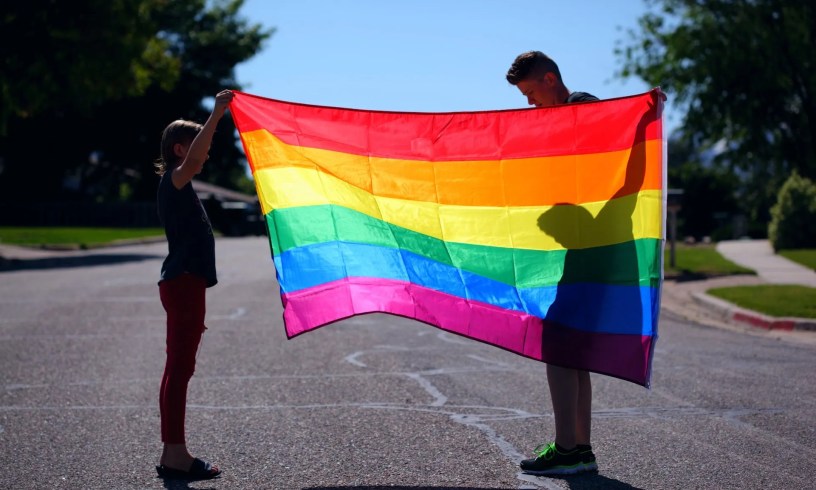
- Header image two people holding a flag: sharonmccutcheon on Unsplash.com
- Image one: Lego rainbow: jamesamolnar on Unsplash.com
- Image two: Rainbow hands: hammadshah123 on Unsplash.com
- Image three: Torn paper rainbow: Katie Rainbow 🏳️🌈 on Unsplash.com
 Psychology at Nottingham Trent University