

By Emily Wan
This week, Emily Wan shares the experience of completing a Scholarship Project for Undergraduate Researchers (SPUR) project. At the time of writing, Emily was a second-year student here at NTU Psychology approaching the end of the project, and now preparing to enter the final year (with some great additional research project experience!). Read on to learn about this exciting research, on Migraine Aura, as well as Emily’s tips if you are inspired to apply for a SPUR project of your own: and keep a look-out for announcements about the next round of SPUR projects in your emails during the academic year.
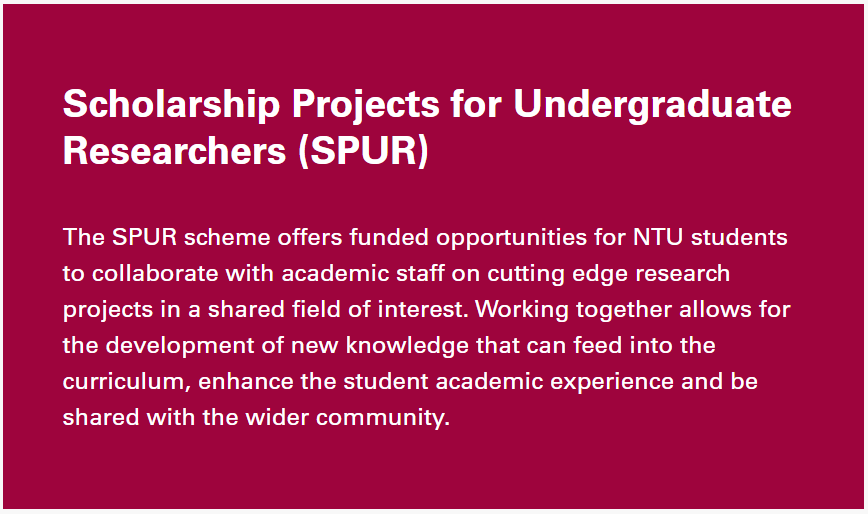
My name is Emily and I am very excited to tell you about my experience working as a research assistant on my SPUR project (Scholarship Project for Undergraduate Researchers). So you may be wondering, what is a SPUR project? A SPUR project is an opportunity for second-year Psychology students to get involved in real-world research during the summer, whilst being supervised by a staff member in the Psychology department at NTU.

Migraine is a debilitating condition, and individuals can experience perceptual changes (i.e. auras) during an attack (often visual), including seeing zig-zag patterns, flashing lights, and experiencing a tingling sensation, like pins and needles. The project that I worked on investigated the brain’s response to contrast masking in individuals with migraine aura compared to a control group (people without migraine aura). Contrast masking is the brain’s response to visual stimuli, for example, when something bright or nearby makes it harder to see something else. Therefore, investigating this may offer a better understanding of migraine aura, as evidence has suggested that people with migraine aura have lower levels of the neurotransmitter, GABA, which can adversely affect someone’s ability to suppress distracting or irrelevant visual information.
I am currently approaching the end of my SPUR project, and I have really enjoyed this experience. As this research area was fairly new to me, I did a lot of literature searching and made extensive notes so that I could understand the topic better and refer back to it if needed. On a day-to-day basis, I am involved in recruiting participants and collecting data in the lab by using EEG (electro-encephalography), a non-invasive neuro-imaging technique used to record brain activity with electrodes placed on the scalp. I did have previous experience using EEG on another research project that I was involved in, so I didn’t find it too daunting to pick up again as I was familiar with wiring-up participants. Through the guidance of my supervisor, I learnt methods of collecting good data and I was also able to develop my problem-solving skills should anything go wrong.
Engaging in a SPUR project this summer has been a fabulous experience, and I am very grateful to have had this opportunity
I was quite interested in gaining an insight into the data ‘cleaning’ and analysis process involved with EEG data as this was something that is beyond the scope of what our modules covered in second year, therefore, asking my supervisor to deliver workshops on this was very helpful. I would like to become a researcher in the future potentially in the field of cognitive neuroscience, so I knew that engaging in a SPUR project would be a good opportunity to gain some research experience to get a better understanding of what working as a researcher is like. Networking with the other SPUR students over the course of this project was fun as I met new people and discussing their work was fascinating as I was able to see how our projects differed. Currently, I am preparing for my poster presentation that I shall deliver at the SPUR conference, and I am very excited to see the findings of the other SPUR students on the other projects!
Applying for a SPUR project
I will now discuss what the process was like when I applied for a SPUR project. In term two, students will receive emails advertising the SPUR projects that the staff members are conducting over the summer period. There are several research projects using a wide variety of research methods, including qualitative, quantitative, or even mixed methods. The staff members are really friendly, so if you have any questions about the project itself, you can contact them. Although the scholarships are competitive, I would strongly encourage applying as early as possible if you are interested, as the project gives you an opportunity to gain a range of transferable skills that would also benefit your employability. Once you have found a project you’re interested in, you should email the lead staff member on that project to inform them of your interest on their project. They shall provide you with details regarding your application. The majority of the projects require sending a CV and cover letter; however, some may require you to write a paragraph about why you’re interested in that project. Secondly, most projects do require an interview, so ensure that you prepare for the interview well and arrive early. Additionally, you may benefit from rehearsing potential interview questions that they may ask you.
So, what makes you stand out as an applicant? Arguably, I think that possessing strong grades really helps with making your application stand out, alongside having good critical thinking and organisational skills. Personally, my project did involve a lot of organisational skills as I had to keep track of scheduling participants to come to the lab for my study, alongside meeting deadlines and balancing other commitments during the summer period. I also think that if you’re engaging in other extra-curriculars, this can demonstrate how you choose to balance your time outside of university other than studying which I think can make an applicant stand out. For me, I was the Welfare Officer in the Social Sciences Society during my second year, and I was also a part-time research assistant prior to applying for SPUR.
I’m very grateful to have had this experience in engaging in a SPUR project this summer, as it has helped immensely with developing my skill set further in the field of Psychology. In my third year, I will be taking on the role as the President of the Social Sciences Society, and I will be continuing as a part-time research assistant. Good luck to candidates applying for future projects!

About the author
Emily studies BSc Psychology with Cognitive Neuroscience and she will be going into her third year of studying at NTU this September. She is also the President of the Social Sciences Society, and her main research interests lies in working memory and visual perception.
- Header image: Scott Graham at Unsplash
- Weary student with a headache: Andrea Piacquadio at Pexels.com
- Make this day great!: Alexas Fotos at Pexels.com
 Psychology at Nottingham Trent University