

by Lucy Betts, Loren Abell, Sarah Buglass & Oonagh Steer
Monday 13th November 2023 marks the start of this year’s Anti-Bullying week in the UK. The weeklong activities are co-ordinated by the Anti-Bullying Alliance. As in previous years, members of NTU Psychology’s Bullying and Aggressive Behaviour research group will be encouraging as many people as possible to join in #OddSocksDay (by wearing a pair of odd socks on Monday 13th November) to celebrate what makes us all unique at the start of Anti-Bullying week.
This year the theme for Anti-Bullying Week is Make a Noise. As part of this year’s Anti-Bullying Week, the Anti-Bullying Alliance are encouraging everyone to have conversations about the difference between banter and bullying. Banter represents a jokey and light-hearted reciprocal exchange between friends that serves to build relationships and strengthen social bonds. Bullying represents an aggressive act that is often repeated, where there is intent to cause harm and a power imbalance between those involved.
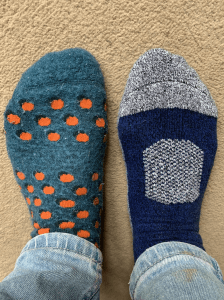
#OddSocksDay
As a group we have been undertaking research exploring banter for the last few years. This line of enquiry started following the findings of a research study with secondary age students exploring cyberbullying. In this study, as part of discussions about the nature of cyberbullying, the young people talked about how banter can become bullying. Over the last few years, we have been undertaking research exploring young people’s and emerging adults’ understanding and experiences of banter. A common theme that emerges in our research is that there is a subjective line around when banter behaviours are considered to become something more aggressive in nature or bullying.
Our research has suggested that there are several factors that can contribute to banter crossing the line of acceptability and becoming bullying including:
- The topic (e.g., banter about personal characteristics/topic (Buglass et al., 2021)
- The social context (e.g., banter with friends and individuals with a shared social understanding is often perceived more favourably)
- How many times the banter is repeated (e.g., overly repetitive banter can result in banter fatigue (Abell et al., 2023)
- The intent behind the banter (e.g., some individuals may use banter as an excuse to mask bullying (Betts & Spenser, 2017)
- The size and nature of the audience (e.g., larger audiences may promote feelings of social embarrassment and/or risk reputational damage)
- The reactions of the target of the banter (e.g., an exchange whether inappropriately intended or not is perceived as problematic if the target is made to feel uncomfortable)
- Emoji use (e.g., emojis may be used to help interpret banter, but they can be ambiguous and may be used downplay inappropriate banter exchanges (Steer et al., 2020)
- Whether the banter is reciprocal (e.g., if one person in the targets the banter at another and that person doesn’t join in, it may indicate that the banter is not appropriate).
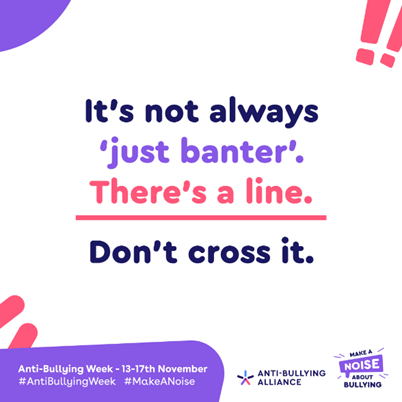
Image from the Anti-Bullying Alliance
How we are using our research
We are particularly proud that we have had the fantastic opportunity, funded by the University’s Innovative Knowledge Exchange Fund, to work with the Anti-Bullying Alliance. Through this funding, we have been able to share some of the insights from our research on banter to help shape some of the content for the primary school and the secondary school packs that the Anti-Bullying Alliance have produced. We have suggested activities for the lesson plans in both packs that were informed by our research. We also want to make a noise about the fact that some of our research on banter involved collaborating with NTU Psychology student researchers who were supported to work with us through the Scholarshop Project for Undergraduate Researchers (SPUR) bursary scheme. The SPUR scheme gives our students the opportunity to work with staff during the summer ahead of the final year of their undergraduate degree. It’s great experience for them and for us, the insights and skills of the student researchers were absolutely crucial to ensure that we collected meaningful and representative data.
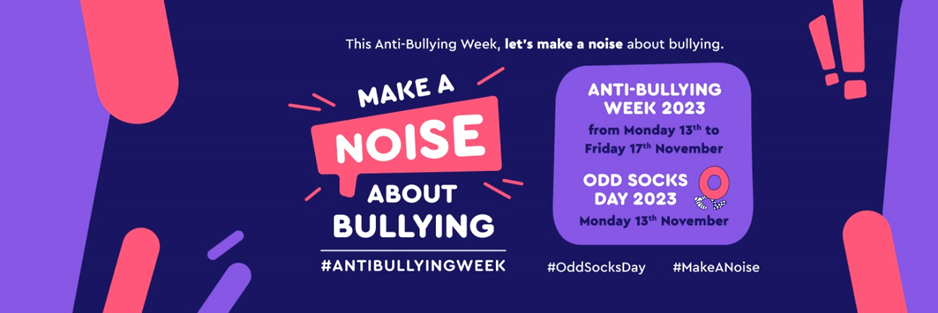
Image from the Anti-Bullying Alliance
We are delighted to have the opportunity to work with the Anti-Bullying Alliance to support them with the development of their primary and secondary school resources. Our involvement in this has been supported by an Innovative Knowledge Exchange Fund award from Nottingham Trent University.
You can access the Anti-Bullying Alliance’s school resources here: School Resources (anti-bullyingalliance.org.uk)
You can read more about the seven ways banter can become bullying here Seven ways that banter can become bullying (theconversation.com)
And you can find out more about our research here: –
- Abell, L. Buglass, S. L., Betts, L. R., & Morohunfola, T. (2023). “It’s all part of the culture”: Undergraduate students’ experiences of banter in university sports clubs and societies. Current Psychology
- Betts, L. R., & Spenser, K. A. (2017). “People think it’s a harmless joke”: Young people’s understanding of the impact of technology, digital vulnerability, and cyber bullying in the United Kingdom. Journal of Children and Media, 11, 20-35.
- Buglass, S., Abell, L., Betts, L. R., Hill, R., & Saunders, J. (2021). Banter versus bullying: A student perspective. International Journal for Bullying prevention, 3, 287-299.
- Steer, O., Betts, L. R., Baguley, T., & Binder, J. F. (2020). “I feel like everyone does it”- Adolescents’ perceptions and awareness of the association between humour, banter, and cyberbullying. Computers in Human Behavior,108: 106297.
Header image: Photo by Nguyễn Lâm from Pexels
 Psychology at Nottingham Trent University