

by John Hudson
If you’ve ever had a job, or heard friends discussing theirs, you’ll know how much work can affect our day-to-day lives. At its best, work can give us a sense of purpose or achievement, and social connection. At its worst, it can be a source of anxiety, uncertainty, monotony, or even fear. Thankfully, Psychology has a lot to offer here, helping us understand and improve jobs and workplaces so they provide more of the good stuff and less of the bad. Which is why, in our latest NTU Psych blog, John Hudson introduces us to one of Psychology’s most widely applicable areas: Occupational Psychology.
Many of us are drawn to Psychology because we want to understand and help people, which is why awareness of potential careers in mental health, or recognised pathways such as Clinical or Forensic Psychology, is generally high among psychology students. But allow me to introduce Occupational Psychology (the psychology of work and organisations), which may just be one of the most versatile areas of psychology you’ve never heard of! Most of us are going to spend a large proportion of our lives at work, so why wouldn’t we want that experience to be healthier, fairer, more motivating, and more meaningful?
Organisations also need to function effectively, and that doesn’t happen by itself. They need to recruit the right people, develop them well, design jobs and work environments where they can perform at their best, and retain talented staff over time. Motivation, leadership, teamwork, wellbeing, communication, decision-making, training and development, fairness, stress, workplace design… all have important psychological aspects. And now there’s Artificial Intelligence, something that promises (or threatens) to completely change the future of work. We might think of that as a solely practical or technological issue, rather than a psychological one, but that would be wrong! For example, how AI-related tools or changes are implemented, whether people trust the systems being introduced, and how employees learn to use them, can all affect motivation, wellbeing and performance. So psychology really is everywhere, and if you like the idea of actually using it to make a difference to real problems, but maybe you’re unsure how that interest might translate into a career or role, Occupational Psychology might be worth a closer look.
So what is it, and who is it for?

Basically, Occupational Psychology is about applying psychological theory and evidence to work and organisations, which can link to so many roles and careers. The trouble is that the name doesn’t really tell us any of that, not to mention that you might also see it referred to by many other names (e.g. Organisational Psychology, Business Psychology, Work Psychology)! Is it any wonder people can get confused? And while we’re clearing up confusion… 1) no, Occupational Psychology is definitely not Occupational Therapy, and 2) Occupational Psychology is not only for people who want to become “Occupational Psychologists”. In fact, that career path is only one of many different directions it can take you, depending on your interests.
And whatever those interests are, there’s a fair chance you can find it somewhere within the field of Occupational Psychology. For example, if you’ve ever been curious about leadership and influence, or why some teams seem to click while others fall apart, that’s social psychology at work. If you’re interested in wellbeing and mental health, there’s a growing recognition of the impact of work-related stress, and how to tackle it. If you enjoy psychometrics, organisations use psychological assessment in everything from recruitment to leadership development, and there are consultancies that specialise in it. And cognitive psychology can be found in the way we process information, make decisions, manage workload, and maintain attention, especially where working conditions affect safety and performance. In other words, you’ll find these and almost every other domain of Psychology somewhere in the world of work.
And organisations are increasingly recognising that things like effective leadership, decision-making, employee wellbeing, and understanding behaviour matter to their own long-term success. So the ability to apply psychology in these settings can be particularly valuable. Psychology isn’t a magic wand, it can’t solve all our problems by itself, but when we really apply it thoughtfully, even small tweaks can make a surprisingly big difference.
What can it actually look like in practice?
Think about your own motivation and how differently you feel when you actually care about what you’re doing compared to when you are just trying to make it through the day. You’ll know the difference it makes to the way work feels and how well we do it. Unsurprisingly then, motivation is a big deal for organisations too. But how do they actually help people to ‘care’? I suppose one option might be to get tougher on performance and targets, and that can certainly focus attention. It may even drive performance up in the short-term, although it can also lead to some rather unfortunate longer-term consequences, such as corner-cutting, gaming the system, or employees looking for the exit. Or maybe an employer could try ‘buying‘ our motivation instead? Bonuses and incentives can be effective in some circumstances, but they can also be expensive, and if they aren’t designed and implemented thoughtfully, those rewards can even backfire and harm the very motivation or behaviour they were intended to improve.

Applying psychology in practice is rarely as simple as taking an idea from research and dropping it into a workplace, and motivation is a good example. Yes, there’s plenty of psychology behind the motivating potential of punishment and rewards, but they’re often applied in rather blunt or simplistic ways. Occupational Psychology can help us do better by considering what actually drives people. For example, Grant and colleagues (2007) studied employees doing what most of us would consider a fairly thankless and rejection-filled job: cold-calling people to ask for donations. Is it surprising that employees might find it difficult to motivate themselves under those circumstances? Yet a simple five-minute intervention, enabling them to meet someone who had benefited from the money raised and see the impact of their work, significantly increased both their persistence and performance.
Would that work as well in every call-centre? Are incentives or bonuses never the answer? No! Every workplace is different, and that’s why learning how to translate theory and evidence into the real world of work and business can be challenging. But that’s also what makes it so interesting and valuable.
However, a lot of management thinking seems to focus on getting the most out of people, rather than designing jobs and conditions that help to get the best from them. Done well, the latter tends to be both better for employees and for the organisation: less wasted time and money, lower turnover, and more sustainable performance. So the ability to apply what we know about people to help organisations, leaders, and teams is highly transferable, and can be valuable whether you go on to use it formally in an Occupational Psychology career, or apply it in any role that involves working with or managing other people.
So it’s not just for “Occupational Psychologists”?
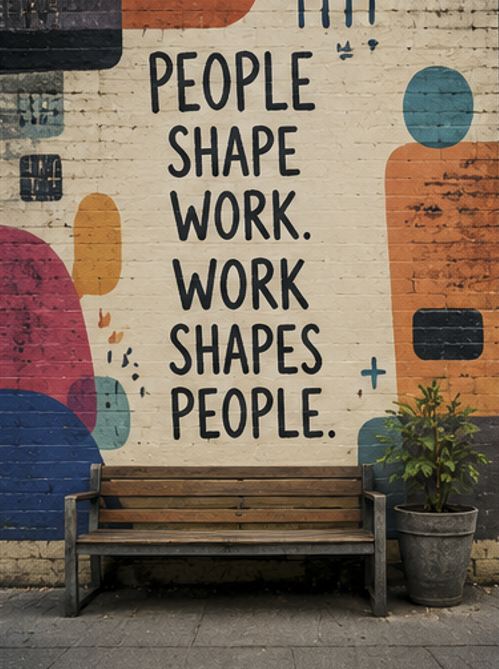
For anyone who does want to pursue the formal professional route towards becoming a Chartered Occupational Psychologist, a relevant BPS-accredited MSc is a necessary starting point. But that’s only one path among many and I think Occupational Psychology is unusually broad as a postgraduate option. The subject can be a springboard to a very wide range of roles; some graduates go into areas closely connected to the field itself, such as roles in workplace wellbeing, recruitment and selection, learning and development, coaching, people analytics, or consultancy. However, others choose to take that same psychological understanding into different industries, business/organisational, or leadership-focused roles, including management and graduate schemes, where understanding things like motivation, behaviour, teamwork or leadership can be a genuine advantage.
‘People skills’ are important, but a solid understanding of how work actually affects people, performance, and behaviour goes a good way beyond that. Studying Occupational Psychology also develops a set of applied capabilities that travel well beyond psychology itself: weighing evidence, translating it into something organisations can actually use, and spotting when a plausible-sounding idea or fashionable HR trend probably won’t survive contact with reality!
If you’re interested…
- Further study: it’s important to note that as a Psychology student or graduate, you’ll already have developed valuable skills that translate well to many careers, so you’re not starting from scratch.
- But if you’re starting to think about postgraduate options and any of this has caught your interest, NTU’s MSc Occupational Psychology is focused on developing the knowledge and skills to translate psychological theory and evidence into real workplace practice. It explores organisational and business psychology, covering topics such as motivation and engagement, leadership, work and wellbeing, psychological assessment, organisational change, and how workplaces can be designed to support both people and performance. Our course is accredited by both the British Psychological Society and the Association for Business Psychology, reflecting both the psychological evidence and the wider business and organisational realities of putting it to use.
- And if you are interested in the specific formal Chartered Occupational Psychologist route, check out these Occupational Psychology job profiles from the BPS and Prospects.
Image credits
- Header image: Compliment And Praise Message Sign by Andrey Popov (via Adobe Stock)
- Stressed employee: AI generated by GPT Image 2 model
- Stacked blocks/target: by Dilok via Adobe stock images
- “People shape work”: AI generated by GPT Image 2 model

