

When we talk about teaching in higher education, the conversation often focuses on curriculum design, assessment, engagement strategies and attainment. Those things are obviously important, but I’ve increasingly found myself thinking about something much simpler: how students actually feel when they walk into our classrooms, whether they feel comfortable enough to speak, whether they feel judged, whether they feel welcome.
Over the years, the feedback that has stayed with me most has rarely been about lecture content. Instead, students talk about feeling supported and understood. They talk about finally feeling confident enough to contribute in class, ask questions or believe they are capable of succeeding. Some mention feeling calmer in sessions. Others describe classes becoming the highlight of their week during particularly difficult periods in their lives.

Reading through recent student evaluations really reinforced this for me. Again and again, students described feeling safe, comfortable and genuinely cared about. They spoke about being able to open up about the realities of university life and feeling accepted as themselves. Several mentioned that what mattered most was not just academic support, but knowing there was somebody approachable who would listen without judgement, and I think there is something important in that.
University can be an incredibly isolating experience for many students. Alongside academic pressure, students may be navigating financial stress, mental health difficulties, neurodivergence, loneliness, caring responsibilities, uncertainty about the future or simply the challenge of trying to find their place in a new environment. Some students arrive already feeling like they don’t fully belong in higher education spaces and that context matters when we think about learning.
A student who feels intimidated or anxious about speaking is less likely to participate or ask for help, while one who feels disconnected from the people around them is unlikely to fully engage with the learning experience. Creating supportive learning communities doesn’t mean removing challenge or lowering standards, as students still need intellectual stretch, critical discussion and opportunities to develop resilience. However, students are much more likely to engage with those challenges when they feel psychologically safe enough to do so.
For me, that often comes down to fairly ordinary human interactions: being approachable, learning students’ names, using humour, showing enthusiasm for the subject, checking in when somebody seems withdrawn, allowing space for different perspectives. In other words, recognising that students are people first, and not just assessment submissions.

Students notice authenticity very quickly; they know when somebody cares about their learning and wellbeing, so they also know when interactions feel transactional. One of the themes that came through strongly in the student comments was the value of staff being open, relatable and human. Students talked about appreciating honesty, warmth and real-life examples because it made learning feel more accessible and less intimidating.
This is especially important when thinking about inclusivity and belonging for neurodivergent students and students from underrepresented backgrounds. A classroom atmosphere that feels welcoming and accepting can have a huge impact on confidence and participation. Sometimes what helps students engage is not a complicated intervention, but simply feeling that they can exist in the space without fear of embarrassment or judgement.
What students often remember years later are not individual PowerPoint slides or perfectly structured seminars. They remember how people treated them. They remember the staff member who encouraged them when they were struggling, helped them believe in their abilities or made university feel less overwhelming during a difficult time.
As educators, I think we sometimes underestimate how much influence small interactions can have. A conversation after class, a reassuring comment before a presentation, showing patience when somebody is struggling or creating an environment where students feel comfortable contributing can shape somebody’s experience of higher education.
Feeling that you belong somewhere changes the way you move through that space, and the effects go well beyond academic performance. It changes confidence, participation and willingness to engage, as well as wellbeing, motivation and even the opportunities students feel able to pursue in the future. For me, creating supportive learning communities is ultimately about helping students feel able to be themselves, and once that happens, learning tends to follow much more naturally.
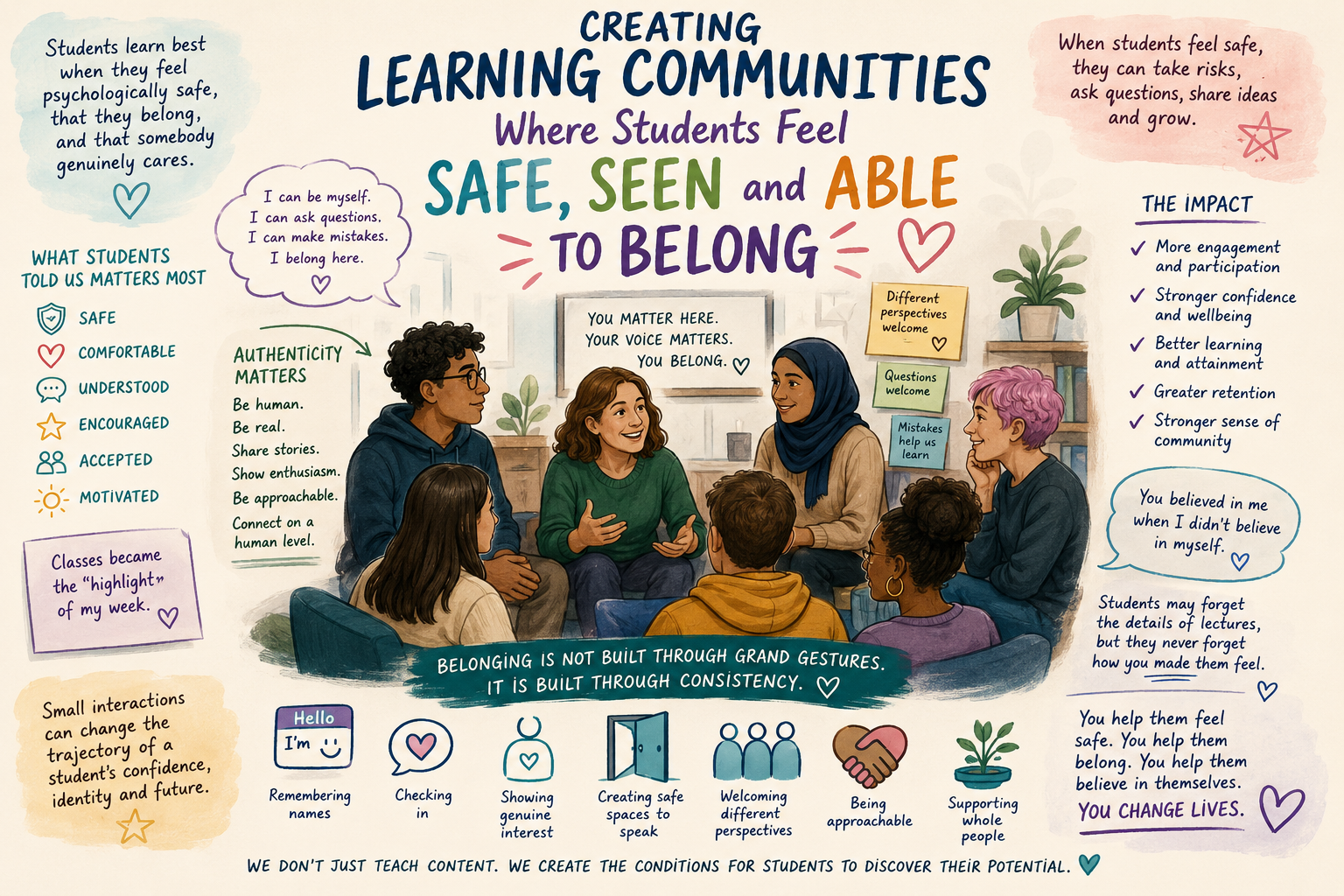
Click to see full text of the above image:
Title: Creating Learning Communities Where Students Feel Safe, Seen and Able to Belong.
Central image: An illustration of six diverse students sitting in a circle, smiling and engaged in conversation. On the wall behind them is a whiteboard that reads “You matter here. Your voice matters. You belong.” alongside sticky notes saying “Different perspectives welcome”, “Questions welcome”, and “Mistakes help us learn.” A speech bubble points to the group reading, “I can be myself. I can ask questions. I can make mistakes. I belong here.”
Top section quotes: * “Students learn best when they feel psychologically safe, that they belong, and that somebody genuinely cares.”
“When students feel safe, they can take risks, ask questions, share ideas and grow.”
Left section: * What students told us matters most: Safe, Comfortable, Understood, Encouraged, Accepted, Motivated.
Authenticity matters: Be human. Be real. Share stories. Show enthusiasm. Be approachable. Connect on a human level.
A sticky note reads: “Classes became the ‘highlight’ of my week.”
Right section:
The impact: More engagement and participation; Stronger confidence and wellbeing; Better learning and attainment; Greater retention; Stronger sense of community.
A speech bubble reads: “You believed in me when I didn’t believe in myself.”
Text below reads: “Students may forget the details of lectures, but they never forget how you made them feel.”
Bottom section:
A central banner reads: “Belonging is not built through grand gestures. It is built through consistency.”
A row of icons outlines key actions: Remembering names (name tag icon), Checking in (speech bubble with a heart), Showing genuine interest (person icon with a heart), Creating safe spaces to speak (open door icon), Welcoming different perspectives (group of people icon), Being approachable (handshake icon), Supporting whole people (plant icon).
Sticky note on the left reads: “Small interactions can change the trajectory of a student’s confidence, identity and future.”
Text on the right reads: “You help them feel safe. You help them belong. You help them believe in themselves. YOU CHANGE LIVES.”
Footer text: “We don’t just teach content. We create the conditions for students to discover their potential
Image credits
- Header image: Vitaly Gariev via Unsplash.com
- Students chatting with tutor: NTU image library
- Students smiling in classroom: NTU image library (photographer: Tracy Proudfoot)
- “Creating learning communities…” infographic: created using Microsoft Copilot AI image tool

